

How Can You Increase Your Trade-In Value Before Buying Your Next Car?
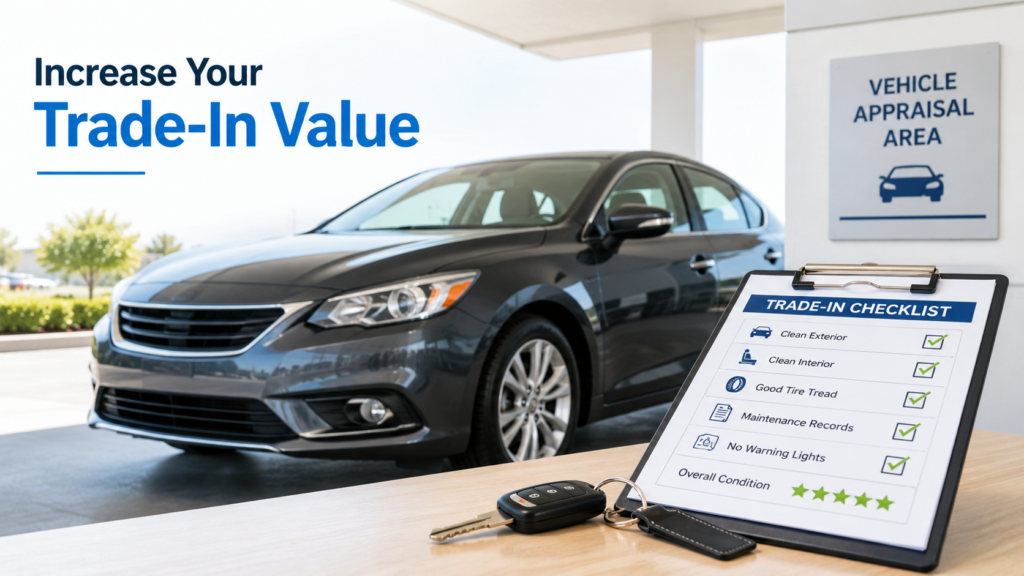
You can increase your trade-in value by cleaning your vehicle, fixing small issues, gathering paperwork, and presenting it honestly before the dealership appraises it.
Top 3 Takeaways
- A clean, well-documented vehicle usually makes a stronger first impression and can help support a better trade-in offer.
- Small, low-cost fixes may be worth doing, but major repairs are usually not worth paying for right before trading in.
- The more prepared you are with service records, keys, title details, and payoff information, the smoother your trade-in process will be.
Trading in your current vehicle can be one of the easiest ways to lower the cost of your next car. Instead of selling your vehicle privately, handling messages, setting up test drives, and negotiating with strangers, you can apply your trade-in value directly toward your next purchase.
The big question is simple: how do you get the best possible offer?
The good news is that you do not need to spend a fortune to make your vehicle more appealing. In many cases, a few simple prep steps can help your car look better, feel better, and appraise more confidently.
At the same time, some repairs and upgrades are not worth the money. Spending $1,500 to maybe raise your offer by $700 does not make sense.
This guide breaks down what helps, what does not, and how to prepare your trade-in the smart way.
What Actually Affects Your Trade-In Value?
A dealership looks at more than just year, make, model, and mileage. Those details matter, but condition, history, demand, and reconditioning cost also play a major role.
If your vehicle is clean, well-maintained, and easy to resell, it may be worth more. If it needs tires, brakes, paint work, deep cleaning, or mechanical repairs, those costs may reduce the offer.
Here are the biggest factors that usually affect trade-in value:
| Factor | Why It Matters |
| Mileage | Lower mileage often means less wear and a longer expected lifespan |
| Condition | Clean interiors, good paint, and fewer repairs can improve value |
| Vehicle history | Accident history, title status, and service records can affect demand |
| Market demand | Popular SUVs, trucks, and fuel-efficient cars may bring stronger offers |
| Trim and options | Leather, sunroof, AWD, safety tech, and premium packages can help |
| Tires and brakes | Worn items may lower the offer because the dealer must replace them |
| Mechanical condition | Warning lights, leaks, noises, and drivability issues reduce confidence |
A trade-in offer is usually based on what the vehicle is worth in its current condition. That means your goal is not to make it perfect.
Your goal is to make it presentable, complete, and easy to evaluate.
Start With a Deep Clean
Cleaning your car is one of the easiest and most affordable ways to improve its trade-in presentation. A clean vehicle suggests that it has been cared for, even before anyone looks under the hood.
You do not need a full professional detail in every situation. A strong wash, vacuum, wipe-down, and odor removal can make a big difference.
Focus on the areas an appraiser will notice immediately: the seats, carpets, dashboard, door panels, cupholders, trunk, wheels, and exterior paint.
If your vehicle has pet hair, smoke smell, food stains, or heavy dirt, consider spending a little more on a professional interior cleaning. Odors and messy interiors can make a vehicle feel rougher than it really is.
Remove Personal Items
Before your trade-in appraisal, remove everything that does not belong with the car. This includes clothes, receipts, chargers, sunglasses, child seats, tools, sports gear, and items in the trunk.
A cluttered vehicle can make it harder to inspect the interior, cargo area, spare tire compartment, and overall condition. It can also make the car feel less maintained.
Check every storage area, including the glove box, center console, seatback pockets, under the seats, and cargo floor.
Also, remove personal information from the infotainment system. Delete saved phones, addresses, garage door codes, and navigation destinations before completing the trade.
Gather Your Maintenance Records
Service records can help show that your vehicle has been properly maintained. Even if they do not dramatically increase the offer, they can make your trade-in easier to evaluate.
Look for records related to oil changes, tire rotations, brake work, battery replacement, fluid services, major repairs, and recall work.
If you do not have paper receipts, check your email, dealership service portal, or repair shop account. Even a simple folder of recent maintenance can help.
Well-documented maintenance is especially helpful on higher-mileage vehicles. It gives the dealership more confidence that the car has not been neglected.
Bring All Keys and Accessories
Extra keys matter more than many shoppers realize. Modern key fobs can be expensive to replace, especially if they include remote start, proximity entry, or smart key features.
If you have two keys, bring both. If you have the owner’s manual, cargo cover, floor mats, wheel lock key, headphones for rear entertainment, charging cables, or removable accessories, bring those too.
Missing items may not ruin your offer, but they can reduce convenience and increase reconditioning costs.
Here is a simple checklist:
| Item to Bring | Why It Helps |
| All key fobs | Replacement keys can be expensive |
| Owner’s manual | Shows the vehicle is complete |
| Floor mats | Helps interior presentation |
| Cargo cover | Important for many SUVs and hatchbacks |
| Wheel lock key | Needed for tire and brake service |
| Service records | Supports maintenance history |
| Title or payoff info | Helps speed up the trade-in process |
Fix Small, Cheap Problems
Some small fixes are worth doing before trading in your vehicle. These are usually low-cost items that improve presentation or remove easy objections.
For example, replacing a burned-out bulb, topping off washer fluid, installing missing valve stem caps, or removing old stickers may be worth the effort.
Small cosmetic improvements can also help. Touching up minor chips, cleaning cloudy headlights, or replacing a torn wiper blade can make the vehicle feel better cared for.
The key is to avoid overspending. Do the simple things that make the vehicle look complete and functional.
Check the Tires
Tires can affect your trade-in value because they are easy to inspect and expensive to replace. If your tires are badly worn, mismatched, damaged, or close to unsafe, the dealership will likely factor that into the offer.
That does not always mean you should buy new tires before trading in. New tires can cost hundreds or even over a thousand dollars, and you may not get that full amount back in your offer.
Instead, make sure the tires are properly inflated and visually clean. If one tire is low, damaged, or has a slow leak, it may be worth having it checked.
If the tires are unsafe, address the issue before driving. If they are simply worn, ask yourself whether replacement makes financial sense before spending the money.
Take Care of Warning Lights Carefully
A dashboard warning light can lower a trade-in offer because it signals uncertainty. The dealership may not know whether the issue is minor or expensive until it performs diagnostics.
If you have a check engine light, ABS light, airbag light, or other warning light, get the issue diagnosed before your appraisal if possible.
A diagnosis does not always mean you need to pay for the repair. Sometimes it simply helps you understand the problem and negotiate with better information.
For example, a loose gas cap or small sensor issue is very different from a transmission problem. Knowing the difference matters.
What Is Worth Spending Money On Before Trading In?
Not every repair is a good investment. Your goal is to spend a little money only when it can protect or improve your offer.
Here are repairs and prep steps that may be worth it:
| Prep Step | Usually Worth It? | Why |
| Basic wash and vacuum | Yes | Improves first impression |
| Interior odor treatment | Sometimes | Helpful if smoke, pets, or mildew are noticeable |
| Replacing burned-out bulbs | Yes | Cheap and easy |
| New wiper blades | Yes | Low cost and improves condition |
| Topping off fluids | Yes | Simple maintenance step |
| Minor paint touch-up | Sometimes | Helpful for small chips, not major damage |
| Professional detail | Sometimes | Best for dirty but otherwise valuable vehicles |
| Full tire replacement | Usually no | Cost may exceed the value gained |
| Major mechanical repairs | Usually no | You may not recover the repair cost |
| Body shop repairs | Usually no | Expensive repairs often do not pay back fully |
A good rule is simple: low-cost improvements are often worth considering, while expensive repairs usually are not.
What Is Not Worth Spending Money On?
Major repairs are usually not worth doing right before trading in. This includes engine work, transmission repairs, full paint jobs, large dent repair, major suspension work, and expensive electronics repairs.
Dealerships often have access to wholesale parts, service departments, vendor pricing, and reconditioning teams. That means they may be able to fix certain issues for less than you would pay retail.
Aftermarket upgrades are also usually not worth adding before a trade. New wheels, stereo systems, lift kits, lighting kits, or appearance accessories may not increase trade-in value the way you expect.
In some cases, modifications can actually hurt value if they narrow the group of future buyers.
Be Honest About the Vehicle’s Condition
It may be tempting to hide issues, but honesty is usually the better strategy. Dealerships inspect trade-ins carefully, and undisclosed problems often show up during appraisal or reconditioning.
If the vehicle has a known issue, explain it clearly. If you have a recent estimate or diagnosis, bring it with you.
Being upfront can help keep the process smooth. It also avoids surprises later in the deal.
A clean, honest presentation is better than trying to make the car seem perfect when it is not.
Know Your Payoff Before You Trade
If you still owe money on your current vehicle, find out your loan payoff before visiting the dealership. Your payoff is the amount required to fully pay off your current loan.
Your trade-in value and loan payoff are not always the same. If your trade-in is worth more than you owe, you may have positive equity.
If you owe more than the vehicle is worth, you may have negative equity. That amount may need to be paid separately or rolled into your next loan, depending on lender approval.
Knowing this number early helps you understand your real buying power.
Time Your Trade-In When Possible
Timing can also affect trade-in value. Market demand changes based on season, fuel prices, inventory levels, and local buyer needs.
For example, trucks and SUVs may be in higher demand in some areas, while fuel-efficient sedans may become more popular when gas prices rise.
Convertibles may perform better in warmer months, while AWD vehicles may attract more attention before winter in colder regions.
You cannot always time the market perfectly, but trading while your vehicle is clean, running well, and still in demand can help.
Do Not Forget the Title and Registration
If your vehicle is paid off, bring the title if you have it. If there is a lienholder, bring your loan information instead.
You should also bring your registration, driver’s license, and any documents the dealership requests.
Having everything ready can make the process faster and easier. It also shows that you are prepared to complete the trade.
If the title has an issue, such as a missing signature or incorrect name, try to resolve it before trading.
A Simple Trade-In Prep Checklist
Use this checklist before your appraisal:
| Task | Done |
| Wash the exterior | |
| Vacuum the interior | |
| Remove personal items | |
| Clean cupholders, dash, and door panels | |
| Remove odors if needed | |
| Gather service records | |
| Bring all keys | |
| Check tire pressure | |
| Replace cheap worn items if needed | |
| Check for warning lights | |
| Get payoff information | |
| Bring title or registration | |
| Delete personal data from infotainment system |
You do not need to make the vehicle look brand new. You just want it to look clean, complete, and ready for a fair appraisal.
Should You Get Multiple Trade-In Offers?
Getting more than one offer can be helpful, especially if you are unsure what your vehicle is worth. Trade-in values can vary depending on the dealership, current inventory, buyer demand, and reconditioning needs.
However, the highest trade-in number is not always the best overall deal. You also need to look at the price of the vehicle you are buying, taxes, fees, financing terms, and total out-the-door cost.
A strong trade-in offer paired with a high vehicle price may not save you money. A slightly lower trade offer with a better purchase price may be the better deal.
Always compare the full transaction, not just one number.
Can Cleaning Really Raise a Trade-In Offer?
Cleaning does not change the year, mileage, or vehicle history. However, it can improve the way the vehicle is perceived during appraisal.
A dirty vehicle can make normal wear look worse. A clean vehicle makes it easier to see the true condition.
If the dealership sees a car that looks cared for, complete, and easy to retail, that can help your case.
At a minimum, cleaning helps prevent your vehicle from being judged more harshly than it should be.
Final Thoughts
Increasing your trade-in value is mostly about smart preparation. Clean the vehicle, gather your records, bring all keys, handle small issues, and avoid wasting money on major repairs right before trading in.
The best approach is practical, not perfect. Spend a little where it makes sense, but do not pour money into repairs you may not recover.
A well-prepared trade-in can help you feel more confident, move through the buying process faster, and potentially lower the amount you need to finance on your next vehicle.
Ready to trade in your current vehicle and upgrade with confidence? Visit Auto Smart, browse our available inventory, and start your credit application today.
Frequently Asked Questions About Increasing Your Trade-In Value
How do I increase my trade-in value quickly?
The quickest ways to increase your trade-in value are to clean the vehicle, remove personal items, bring all keys, gather maintenance records, and fix small, low-cost issues. A clean and complete vehicle is easier to appraise and can make a better first impression.
Is it worth detailing my car before trading it in?
Detailing may be worth it if your vehicle is dirty, stained, or has noticeable odors. If the car is already clean, a basic wash and vacuum may be enough. The goal is to improve presentation without spending more than you are likely to gain.
Should I fix dents before trading in my car?
Small dents may not be worth repairing unless the cost is low. Major body repairs are often expensive and may not increase your offer enough to justify the cost. It is usually better to get an appraisal first before paying for larger cosmetic repairs.
Should I replace tires before trading in my vehicle?
Usually, it is not worth buying a full set of new tires right before trading in. Tires can affect the offer, but you may not recover the full replacement cost. Make sure the tires are properly inflated and safe, but think carefully before spending hundreds of dollars.
Do service records help trade-in value?
Service records can help show that the vehicle has been maintained properly. They are especially useful for higher-mileage vehicles or cars with recent major maintenance. While they may not guarantee a higher offer, they can make the vehicle more appealing.
Can I trade in a car if I still owe money on it?
Yes, you can usually trade in a car even if you still owe money on it. The dealership will compare your trade-in value to your loan payoff. If you owe less than the car is worth, you may have equity; if you owe more, you may have negative equity that must be handled in the deal.
